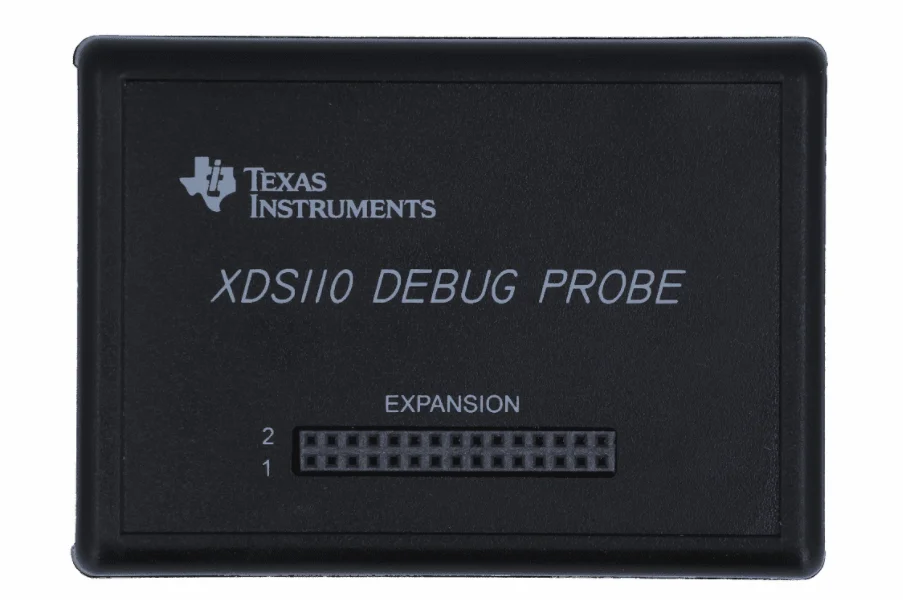
TMDSEMU110-U XDS110 JTAG debugging probe The Texas Instruments XDS110 is a new debug probe (emulator) for TI embedded processors. The XDS110 replaces the XDS100 family while supporting a wider range of standards (IEEE1149.1, IEEE1149.7, SWD) in a single pod. In addition, all XDS debug probes support kernel and system tracking in all ARM and DSP processors with embedded trace buffers (ETBs).
The TI XDS110 connects to the target board via TI 20-pin connectors (with multiple adapters for TI 14-pin and ARM 10-pin and ARM 20-pin) and to the host PC via USB2.0 high speed (480Mbps). It also has two additional connections: an auxiliary 14-pin port connector for EnergyTrace™, a full-duplex UART port and four general-purpose I/ OS, and an extended 30-pin connector for connecting the XDS110 EnergyTrace HDR plug-in.
If you use Code Composer Studio, version 7.0 or later is required.
The XDS110 package includes:
XDS110 debug pod 20-pin debugging cable 14 pin auxiliary cable TI 20 pin to TI 14 pin converter adapter TI 20-pin to ARM Cortex 20-pin converter adapter TI 20-pin to ARM Cortex 10-pin converter adapter USB cable Auxiliary cable distribution board Quick start Guide Supported devices:
SimpleLink MCU (CC13xx, CC26xx, CC3x, MSP432) C2000, TM4C12x and Hercules microcontrollers Sitara (AM335x, AM43xx, AM57xx, AM65xx, AMIC1xx) Automotive SoC (TDAx ADAS, DRAx Infotainment System) Millimeter wave sensor (IWR/AWR14xx, IWR/AWR16xx, IWR68xx) C674x and C66x (Keystone I) floating point DSP C642x and C645x 66AK2 and TCI66x Multi-Core DSP + ARM® SoC (Keystone II) C55x Low power DSP UCD3x digital power supply device PGA970 SoC Other TI SoCs with PRU, C674x, C66xx, Cortex M, Cortex R, and Cortex A cores Unsupported devices: MSP430 microcontroller ARM9 based processors using adaptive clocks, such as OMAPL13x, AM1xxx, DM64xx AWR12xx millimeter wave sensor C54x C62x, C670x, C671x, C672x, C640x and C641x trait Serial line debugging (SWD) and Serial Line Output (SWO) are available for selected microcontrollers and wirelessly connected microcontrollers Kernel and system tracking is available through ETB in selected ARM and DSP processors For more information about the tracking capabilities of a particular device, see its Technical Reference Manual (TRM) You will need:
Installation of Code Composer Studio v7 (or later) or a compatible third party development environment. A target board with one of the compatible JTAG connectors. You may need:
Adapters that allow connections to target boards with different JTAG connectors Shipping information:
Product box size: 260mm x 200mm x 50mm (10.0in x 8.0in x 2.0in) Weight: 240g (8.0oz)
peculiarity The XDS110 is the latest entry-level debug probe (emulator) for TI embedded processors. Designed to be a complete solution that provides JTAG and SWD connectivity at low cost, the XDS110 is the go-to debug probe for entry-level debugging of TI microcontrollers, processors, and SimpleLink devices.
The XDS110 replaces XDS100 technology and is the first debug probe to support all TI devices with JTAG, cJTAG, and SWD/SWO debug ports in a single product. In addition, all ARM and DSP devices that support embedded Trace buffers (ETBs) can use core processor and system trace.
The XDS110 is also the first in the XDS series of debug probes with EnergyTrace for the MSP432 and its add-on module XDS110 EnergyTrace HDR for SimpleLink wireless connected devices. EnergyTrace is a technology that allows the measurement of the true energy and power consumption of the target board, which can measure up to 75mA of native current and up to 800mA of additional modules. For added flexibility, EnergyTrace's same physical connection also features a UART port and four GPIOs for full hardware control.
The XDS110 is designed to replace the aging XDS100 series JTAG debugger with higher JTAG and cJTAG data throughput, adding support for ARM serial line debug mode at the same cost.
Following the trend of reduced space on modern TI development boards, the XDS110 uses the standard TI 20-pin connector as the primary JTAG connection to the target. In addition to this, all variants feature modular target configuration adapters for TI and ARM standard JTAG connectors (adapter availability varies by model).
The XDS110 series supports traditional IEEE1149.1 (JTAG) as well as IEEE1149.7 (cJTAG) and ARM Serial Line Debugging (SWD)/ Serial Line Output (SWO) and operates at interface levels from +1.8V to +3.6V.
IEEE1149.7 or Compact JTAG (cJTAG) is a significant improvement over traditional JTAG as it supports all of its features using only two pins and can be used with selected TI wireless connected microcontrollers.
Serial line debugging (SWD) is a debugging mode that uses two pins (JTAG uses four) and transfers data at a higher clock rate than JTAG. The Serial Line Output (SWO) adds a pin that allows simple tracing operations to be performed on selected Cortex M4 microcontrollers.
The XDS110 supports a USB2.0 full speed (11Mbps) or high speed (480Mbps) connection to the host computer.
The XDS110 series is fully compatible with TI's Code Composer Studio IDE. This combination provides a complete hardware development environment that includes an integrated debug environment, compiler, and full hardware debugging and tracing capabilities on selected TI microcontrollers, processors, and wirelessly connected microcontrollers.
Other XDS products:
XDS110 EnergyTrace HDR XDS200 XDS560v2 system tracking with USB XDS560v2 system tracking with USB and Ethernet XDS560v2 PRO TRACE receiver
XDS110 debug pod 20-pin debugging cable 14 pin auxiliary cable TI 20 pin to TI 14 pin converter adapter TI 20-pin to ARM Cortex 20-pin converter adapter TI 20-pin to ARM Cortex 10-pin converter adapter USB2.0 data cable English Quick Start guide flyer Korean quick Start Guide flyer Terms and Conditions leaflet
You may also like
Join our community
Stay updated on the latest innovations and insights in automation.